


Lifting, Starting with Ultrasound (HIFU) and Radiofrequency (RF)
Lifting Series ① — Once you know which energy reaches which layer, the treatments explain themselves
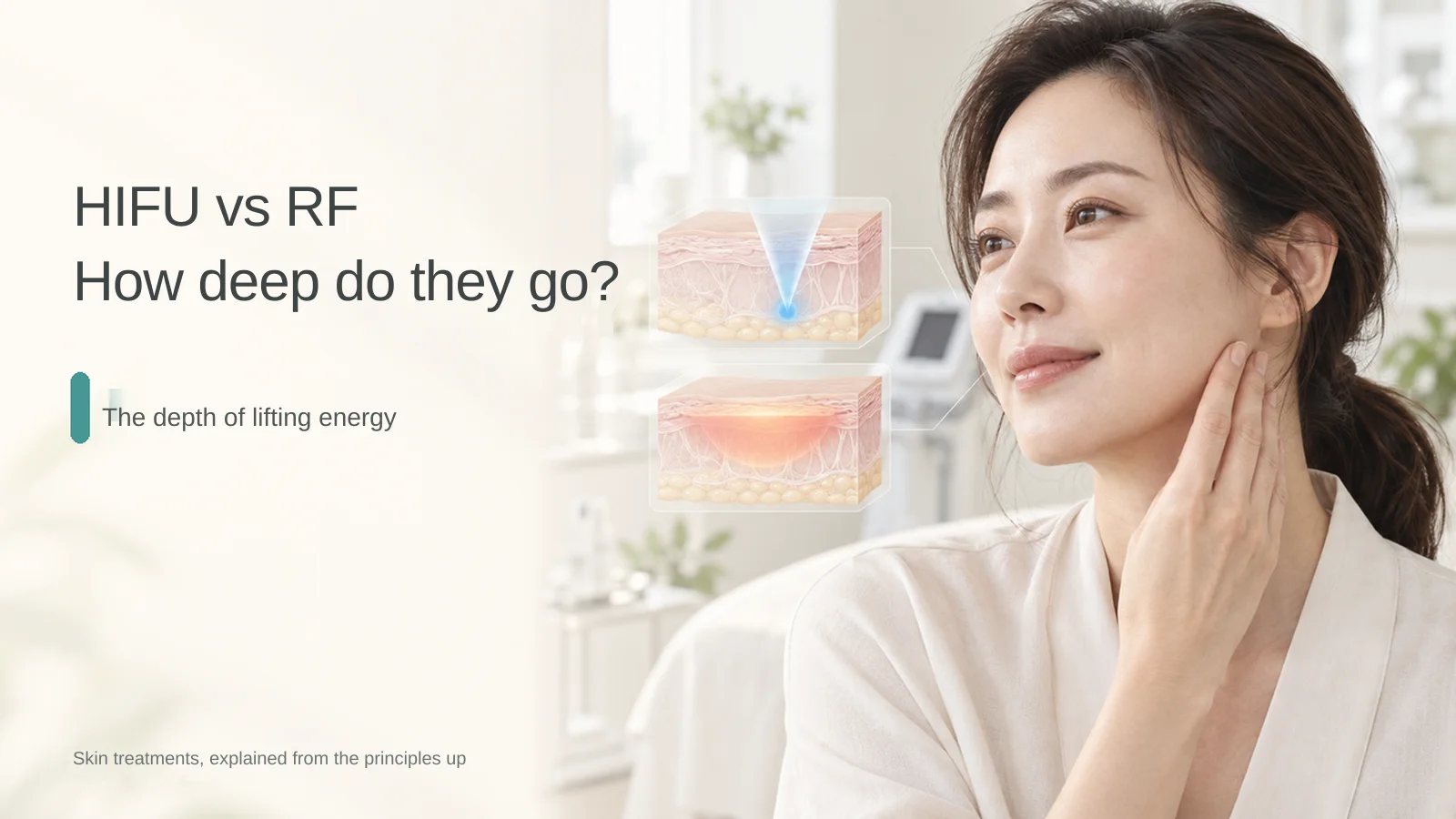
When I consult with patients in the clinic, I always keep a slide deck open and start with the basics. Devices that people know only by name fall into a few broad categories, and each category leads to a different kind of result — this takes some time to explain. Someone who walks in saying "I want that one!" without knowing what it does often needs to hear, "Actually, this other thing would serve you better."
This series puts that explanation into writing. There is only one thing to hold on to — which energy reaches which layer of the skin. This first article is the overview; the next covers the two methods within radiofrequency, then Density versus Thermage, and finally Density's tips and shot counts.
The face is built in layers
From the outside in: epidermis → dermis → subcutaneous fat → SMAS (the fascial layer). Sagging usually means the deeper layer (SMAS) has descended; loss of firmness means collagen in the dermis has thinned. Because the same "sagging" can come from different layers, lifting treatments are divided by which layer the energy is delivered to.
Ultrasound (HIFU) — reaching the deep layer point by point
High-intensity focused ultrasound gathers ultrasound into a single point, like a magnifying glass focusing light, and creates heat only at that point. That lets it pass through the skin surface and reach deep layers like the SMAS as a series of points. It is a "pulling" lift that raises a layer that has descended.
Ultherapy is the representative device. Results peak at 1 to 1.5 months after treatment and last 8 to 9 months. The face is treated from the temples to under the chin; the eye area is treated separately with Eye Ultherapy. Shurink belongs to the same ultrasound family, repeated at 2- to 3-month intervals and lasting 3 to 4 months.
Radiofrequency (RF) — treating the dermis as a surface
Radiofrequency creates heat as electrical current passes through tissue. Rather than points, it builds heat across a surface in the dermis and remodels collagen. Instead of pulling deep layers, it is a lift that restores skin density and firmness.
Thermage FLX and Density belong here. Thermage lasts 10 to 12 months, Density 6 to 12 months, and both peak at 1 to 1.5 months. What separates the two, given that both are radiofrequency, is the subject of the next articles.
Other energies
ONDA is neither ultrasound nor radiofrequency but microwave, and it addresses dermal firmness and subcutaneous fat together. It has a place in sagging mixed with fat — a double chin or full cheeks — and lasts 4 to 5 months. Thread lifting is not an energy at all: threads physically anchor the tissue, so it lasts 12 months or more.
At a glance
| Treatment | Energy | Layer reached | Character | Duration |
|---|---|---|---|---|
| Ultherapy | Ultrasound (HIFU) | SMAS (fascia) | Pulls the deep layer point by point | 8–9 months |
| Shurink | Ultrasound (HIFU) | SMAS · dermis | Lighter, repeated | 3–4 months |
| Thermage FLX | Radiofrequency (RF), monopolar | Dermis | Density and firmness as a surface | 10–12 months |
| Density | Radiofrequency (RF), monopolar · bipolar | Dermis | Depth divided by tip | 6–12 months |
| ONDA | Microwave | Dermis · subcutaneous fat | Fat and firmness together | 4–5 months |
| Thread lifting | Threads (physical anchoring) | Subcutaneous | Pulls and holds | 12 months or more |
How ReYeonK uses them
We do not push a single answer. What has sagged is pulled with ultrasound, a thinned dermis is filled with radiofrequency, and where fat is involved, ONDA is added. This is why Ul-Thermage — Ultherapy and Thermage on the same day — is ReYeonK's signature combination: the layers differ, so the two do not replace each other; they stack.
Before deciding what to have, we look at which layer is the problem. We take photographs and review them together in consultation.
Cost and details
Prices can be found in the current event packages.
Results and duration vary between individuals. The right plan is decided in consultation, after examining your skin.
Treatments in this article
More from the Doctor's Column